
How Pakistan Changed Its Military Command Structure
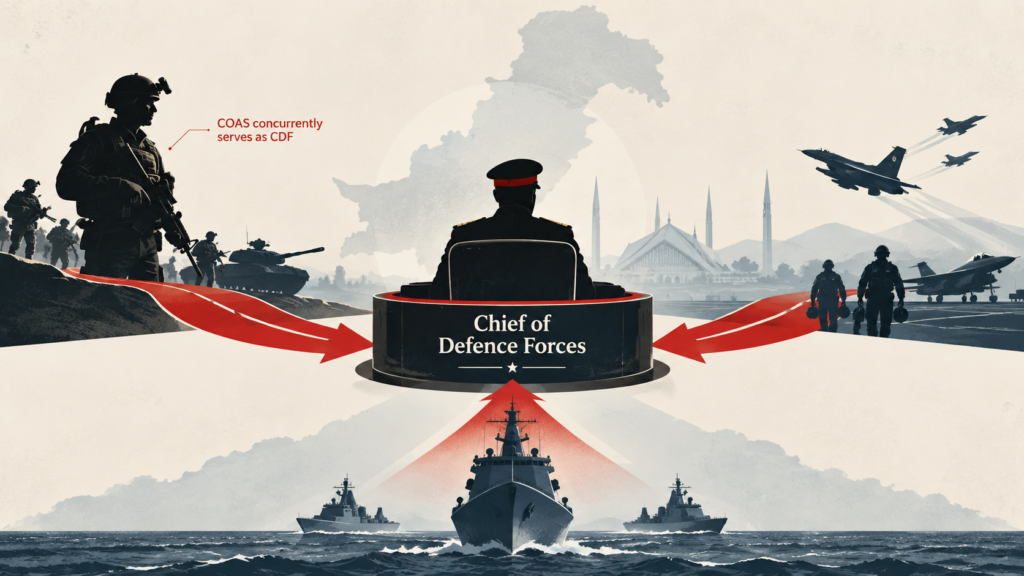
Pakistan has replaced its old joint military coordination system with a new structure centered on the Chief
of Defence Forces (CDF). The CDF an office held concurrently by the Army chief now has operational command
and control across the Armed Forces, while constitutional control and command remain with the Federal Government.
Last updated: 25 September 2026
Before November 2025
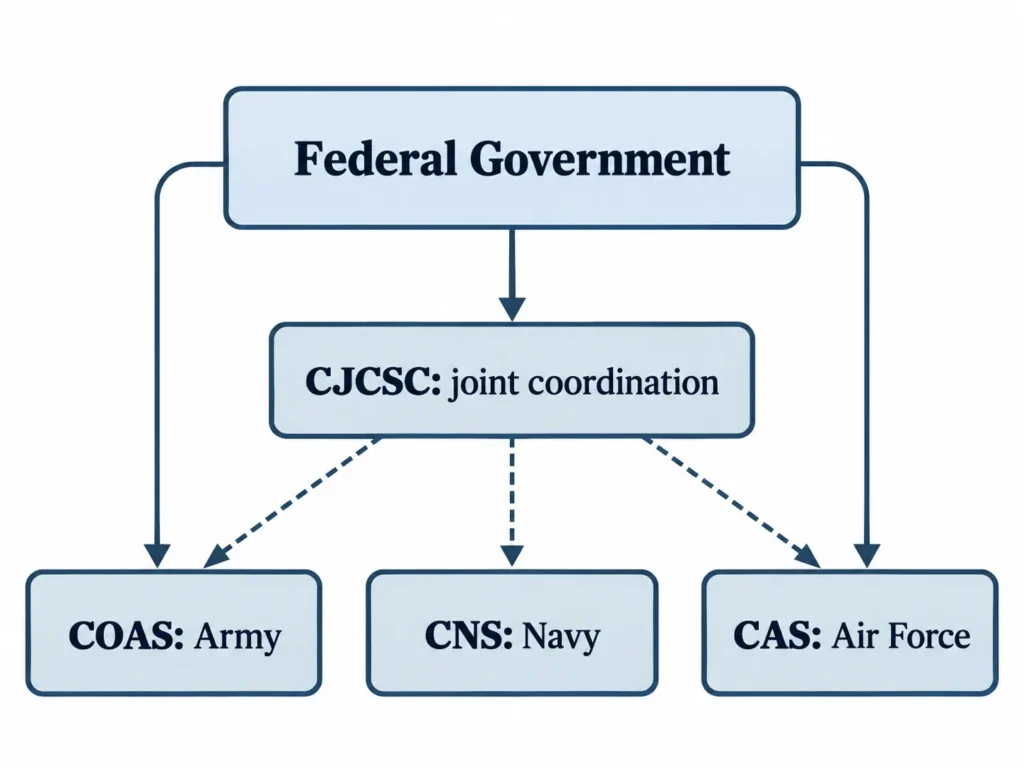
For nearly five decades, Pakistan’s Army, Navy and Air Force retained their own operational command structures.
Operational command, in simple terms, means the authority to direct military forces and decide how they are
used in operations.
At the centre of the joint military system was the Chairman Joint Chiefs of Staff Committee (CJCSC), a position
created in 1976.
The CJCSC facilitated inter-service coordination and joint strategic planning, while the individual service chiefs
retained operational command of their respective forces. The chairman did not exercise operational command over the
Army, Navy or Air Force.
In simple terms, Pakistan had a mechanism for bringing the three services together, but no single officer with
operational command over all three.
What changed?
In November 2025, Parliament passed the **27th Constitutional Amendment**.
The amendment revised Article 243, introducing the position of **Chief of Defence Forces (CDF)** and
abolishing the office of CJCSC with effect from **27 November 2025**.
Under the new arrangement, the Chief of Army Staff concurrently serves as the CDF, while the Navy and Air Force
retain their own service chiefs. The President appoints the COAS/CDF and the other service chiefs on the advice
of the Prime Minister.
**Field Marshal Asim Munir** currently holds both the COAS and CDF positions.
Defence Forces Headquarters
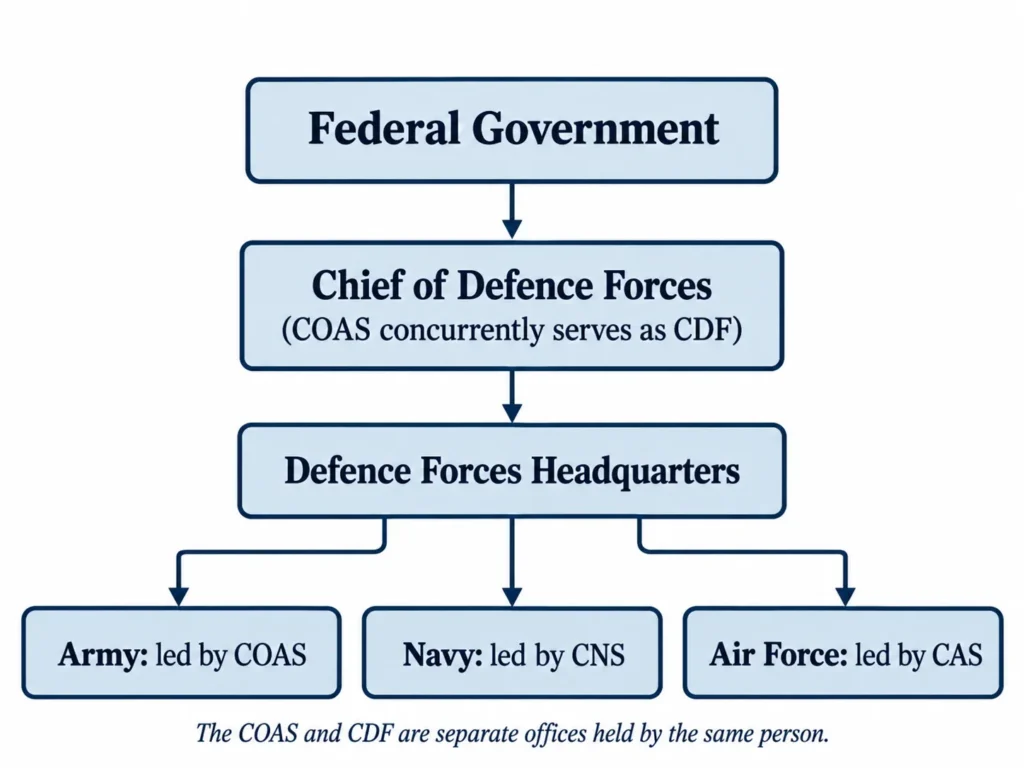
The **Defense Forces of Pakistan Act, 2026**, which received presidential assent on **20 August 2026**, provided
the statutory framework for the new command system. It was given retrospective effect from **13 November 2025**.
The Act establishes **Defence Forces Headquarters (DFHQ)** as the headquarters of the Armed Forces, operating
under the command and authority of the CDF.
It expressly gives the CDF **operational command and control of the Armed Forces**, with responsibility to the
Federal Government for those matters. The CDF also serves as the principal military adviser to the Prime Minister
on national security, defence and matters relating to the Armed Forces.
The central difference is therefore a shift from the CJCSC’s primarily coordinating role to the CDF’s statutory
operational command across the three services.
Additional powers
The 2026 Act also empowers the CDF to retire, release, discharge or retain personnel, accept or reject
resignations, and relax retirement age or service limits.
These powers apply to people governed by armed-forces laws, **excluding those appointed under Article 243
of the Constitution
The question of rotation
The CJCSC could be drawn from the Army, Navy or Air Force. In practice, however, the Army dominated the
position: 15 out of 18 were Army officers, two were naval officers and one was an Air Force officer**.
The CDF has no such equivalent scope for selection across the services. Article 243 explicitly links the
position to the Chief of Army Staff, constitutionally tying it to the Army chief.
How long can the CDF serve?
The President appoints the COAS/CDF on the Prime Minister’s advice for **five years**. Munir’s December 2025
appointment takes his current term to **December 2030**.
Changes to nuclear command
The 27th Amendment also introduced the office of **Commander of the National Strategic Command (CNSC)**.
The Prime Minister appoints the CNSC from the Pakistan Army on the recommendation of the COAS/CDF.
The amended Pakistan Army Act provides for the appointment of a general for a **three-year tenure**.
Reappointment or extension is also decided by the Prime Minister on the COAS/CDF’s recommendation.
General Syed Aamer Raza was promoted to a four-star general and appointed as the first CNSC.
The **National Command Authority (Amendment) Act, 2026** separately replaced references to the CJCSC
with the COAS/CDF and added the CNSC as a member. The Prime Minister remains chairman of the
National Command Authority. The changes therefore redistribute responsibilities within the
nuclear-command framework.
What protections come with five-star rank?
Field Marshals, Admirals of the Fleet and Marshals of the Air Force retain their rank, uniform and privileges
for life.
Their removal follows Article 47, requiring specified constitutional grounds and a two-thirds majority of the
Parliament. Munir receives this protection as a Field Marshal, rather than simply as CDF.
“By comparison, removing a prime minister through a vote of no confidence requires a simple majority of the
total membership of the National Assembly.
They also receive presidential-style protections under Article 248, including lifetime protection against criminal
proceedings and court-issued arrest or imprisonment, subject to its conditions. ** Critics, including
“Amnesty International argues that the amendment insulates senior military leadership from accountability”
Why was the system changed?
The official aim is to make the Army, Navy and Air Force plan and operate together more effectively. The 2026 Act
identifies closer integration and coordination as key goals. Munir has also argued that changing security threats
require a unified system linking the three services.
Supporters point to a limitation in the old arrangement: the CJCSC could coordinate planning but could not command
the three services’ operations. They argue that putting command authority in one office could reduce delays and allow
faster decisions during a crisis, when actions across different services need to fit together.
The government also linked the reforms to strengthening defence capabilities after the **May 2025 conflict with India**.
That was its stated justification; it does not establish that the previous command structure failed during the conflict.
Whether the new arrangement actually improves military performance will need to be assessed in practice.
Why is the change controversial?
The main concern is **how much authority now rests with one officer**. The Army chief also commands the wider Armed
Forces. Critics argue that this strengthens the Army’s dominance and makes it harder to maintain a balance between
the three services.
Defence researchers Haleema Saadia and Ali Mustafa warn that concentrating leadership in the Army could sideline naval
and air perspectives, including in nuclear planning.
These are concerns about how the system could operate, rather than
proof that those services have already lost their influence.
There is also the question of **civilian oversight**. Critics fear that a more powerful military chief could become
harder for elected leaders to hold accountable, even where civilian authority remains formally recognised.
The military’s response is that unified command will preserve each service’s internal organisation and autonomy.
The 2026 Act also explicitly makes the CDF responsible to the Federal Government for operational command and control.
The dispute concerns how effectively those safeguards will work in practice.
What happens next?
The real test is how the new system works in practice. How much influence will the Navy and Air Force have in joint
decisions? Will the services plan and conduct operations together more effectively? And how will civilian leaders
hold the CDF accountable?
The answers will determine how significant this restructuring ultimately becomes.